Boligfritid.dk is a Danish magazine for homeowners. This English version is written for international residents in Denmark. Read the original in Danish.
About this article
Partnership: This article contains links to our partner H-Energi ApS, which sells and installs heat pumps. The rankings are sorted by the figures alone, and H-Energi has had no influence on them.
The figures come from the manufacturers’ own data sheets and product sheets (collected on 29 September 2026 and checked in October 2026). We have not measured the heat pumps ourselves. Always check the current data sheet before you buy.
An air-to-water heat pump is the most common way to replace an oil or gas boiler in Denmark. But data sheets are hard to compare: one manufacturer gives the sound level at one metre, another at five. One gives the seasonal efficiency for an average climate, another without stating a climate zone. Here we have collected the figures for 11 popular models on the Danish market and ranked them by the two things most homeowners ask about: how efficient the heat pump is, and how much noise it makes.
How to read the figures
- SCOP is the heat pump’s seasonal efficiency over a year. A SCOP of 5 means that over a year you get roughly 5 kWh of heat for every kWh of electricity. Higher is better. SCOP at a 35 °C flow temperature suits underfloor heating. SCOP at 55 °C is a better fit for a house with radiators.
- COP is the efficiency at one specific operating point, e.g. 7 °C outside. It is always higher than SCOP and tells you less about your electricity bill. That is why we rank by SCOP.
- Climate zone: SCOP is calculated for a cold, average or warm European climate. Denmark is closest to average. Some manufacturers do not state the climate zone, and then the figure is not fully comparable.
- Sound power (LWA) is the sound the unit itself emits, measured according to EN 12102. It can be compared across brands. Lower is better.
- Sound pressure is what you hear at a particular spot, e.g. 1, 3 or 5 metres from the unit. The figure falls with distance, so sound pressure can only be compared at the same distance. Between 1 and 5 metres the difference is typically 12–14 dB.
- Max. flow temperature is how hot the water the heat pump can produce. The higher it is, the better the chance that your old radiators can stay.
- Lowest outdoor temperature is how cold it can get before the heat pump stops or hands the heating over to an electric immersion heater.
Ranking 1: Best seasonal efficiency (SCOP at 35 °C)
Highest is best. This figure suits houses with underfloor heating or large radiators.
| # | Model | Size | SCOP 35 °C |
|---|---|---|---|
| 1 | Nordic PRO 9* | 9 kW | 5.56 |
| 2 | NIBE S2125-14 | 14 kW | 5.27 |
| 3 | LG Therma V R290 16 kW | 16 kW | 5.11 |
| 4 | Klimadan PowerSaverAir 18 | 18 kW | 5.01 |
| 5 | Vaillant aroTHERM plus VWL 125/6 | 12 kW | 4.96 |
| 6 | Viessmann Vitocal 250-A A13 | 13 kW | 4.96 |
| 7 | Thermia iTec XTR L | 12 kW | 4.90 |
| 8 | Panasonic Aquarea L WH-WDG09 | 9 kW | 4.83 |
| 9 | Samsung EHS Mono R290 16 kW | 16 kW | 4.70 |
| 10 | Daikin Altherma 3 M 16 kW | 16 kW | 4.69 |
| 11 | Bosch Compress 5800i AW 12 | 12 kW | 4.66 |
* Nordic PRO 2026: the manufacturer’s own figures (Nordic Refrigeration Solutions, October 2026). SCOP is stated at 35 and 55 °C flow temperature without a climate zone.
Size matters: smaller models in the same series often have a slightly higher SCOP. The 7 kW LG Therma V R290 is stated at 5.24 (LG: certification pending), and Vaillant’s newer aroTHERM plus VWL 125/8.1 is listed at 5.08 on Energistyrelsen’s (the Danish Energy Agency’s) heat pump list. Nordic PRO 12–22 come in at 5.09–5.19. On the heat pump list, the Klimadan PowerSaverAir 18 is listed at 4.91, the Samsung 16 kW at 4.61 and the Viessmann A13 at 5.10. The difference is because the list uses the figures submitted to Energistyrelsen.
Ranking 2: Best for radiators (SCOP at 55 °C)
If you have radiators, SCOP at 55 °C is the most realistic figure. Max. flow temperature shows how hot the water the heat pump can deliver on the coldest days.
| # | Model | SCOP 55 °C | Max. flow temp. |
|---|---|---|---|
| 1 | Nordic PRO 9* | 4.09 | 80 °C |
| 2 | NIBE S2125-14 | 4.06 | 75 °C |
| 3 | Viessmann Vitocal 250-A A13 | 3.93 | 70 °C |
| 4 | LG Therma V R290 16 kW | 3.92 | 75 °C |
| 5 | Vaillant aroTHERM plus VWL 125/6 | 3.75 | 70 °C |
| 6 | Panasonic Aquarea L WH-WDG09 | 3.68 | not stated |
| 7 | Thermia iTec XTR L | 3.65 | 75 °C |
| 8 | Klimadan PowerSaverAir 18 | 3.64 | 75 °C |
| 9 | Samsung EHS Mono R290 16 kW | 3.55 | 75 °C |
| 10 | Bosch Compress 5800i AW 12 | 3.51 | 75 °C |
| 11 | Daikin Altherma 3 M 16 kW | 3.37 | 60 °C |
Ranking 3: Quietest (sound power LWA)
Lowest is best. Sound power according to EN 12102 is the figure that can be compared across brands. Remember that 10 dB less is perceived as roughly half as much sound.
| # | Model | Size | Sound power |
|---|---|---|---|
| 1 | Bosch Compress 5800i AW 12 | 12 kW | 45*** dB(A) |
| 2 | Nordic PRO 9* | 9 kW | 48 dB(A) |
| 3 | NIBE S2125-14 | 14 kW | 52 dB(A) |
| 4 | LG Therma V R290 16 kW | 16 kW | 52 dB(A) |
| 5 | Viessmann Vitocal 250-A A13 | 13 kW | 54 dB(A) |
| 6 | Thermia iTec XTR L | 12 kW | 54 dB(A) |
| 7 | Vaillant aroTHERM plus VWL 125/6 | 12 kW | 58 dB(A) |
| 8 | Klimadan PowerSaverAir 18 | 18 kW | 62 dB(A) |
| 9 | Daikin Altherma 3 M 16 kW | 16 kW | 62 dB(A) |
| 10 | Samsung EHS Mono R290 16 kW | 16 kW | 65 dB(A) |
| – | Panasonic Aquarea L WH-WDG09 | 9 kW | unresolved** |
*** Bosch: 45 dB(A) is the ErP figure. For Energistyrelsen’s noise calculator, Bosch itself states a maximum of 60 dB(A) during the day. ** Panasonic: the heat pump list states 54 dB(A), but the EU product sheet states 63 dB(A) for the outdoor unit. We have not been able to resolve the difference. Smaller sizes are often quieter: NIBE S2125-12 comes in at 49, LG Therma V R290 7 kW at 49 and Vaillant VWL 125/8.1 at 50 dB(A).
* Nordic PRO 2026: the manufacturer’s own figures (Nordic Refrigeration Solutions, October 2026). SCOP is stated at 35 and 55 °C flow temperature without a climate zone. The model is not on Energistyrelsen’s heat pump list, and the figures have not been independently checked. The other figures come from the manufacturers’ data sheets, Keymark or EU product sheets.
All figures in one table
| Model | Size | SCOP 35 °C | SCOP 55 °C | Sound power dB(A) | Max. flow temp. °C | Lowest outdoor temp. °C | Refrigerant |
|---|---|---|---|---|---|---|---|
| Nordic PRO 9* | 9 kW | 5.56 | 4.09 | 48 | 80 | –30 | R290 |
| NIBE S2125-14 | 14 kW | 5.27 | 4.06 | 52 | 75 | –25 | R290 |
| LG Therma V R290 16 kW | 16 kW | 5.11 | 3.92 | 52 | 75 | –28 | R290 |
| Klimadan PowerSaverAir 18 | 18 kW | 5.01 | 3.64 | 62 | 75 | –25 | R290 |
| Vaillant aroTHERM plus VWL 125/6 | 12 kW | 4.96 | 3.75 | 58 | 70 | not stated | R290 |
| Viessmann Vitocal 250-A A13 | 13 kW | 4.96 | 3.93 | 54 | 70 | –20 | R290 |
| Thermia iTec XTR L | 12 kW | 4.90 | 3.65 | 54 | 75 | –25 | R290 |
| Panasonic Aquarea L WH-WDG09 | 9 kW | 4.83 | 3.68 | unresolved** | not stated | not stated | R290 |
| Samsung EHS Mono R290 16 kW | 16 kW | 4.70 | 3.55 | 65 | 75 | –25 | R290 |
| Daikin Altherma 3 M 16 kW | 16 kW | 4.69 | 3.37 | 62 | 60 | –25 | R32 |
| Bosch Compress 5800i AW 12 | 12 kW | 4.66 | 3.51 | 45*** | 75 | not stated | R290 |
A closer look at the Nordic PRO 2026
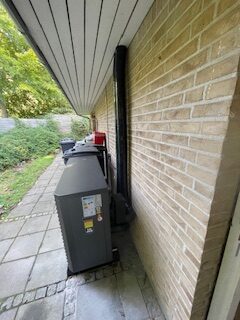
The Nordic PRO 2026 comes from Nordic Refrigeration Solutions in Vejle and is available in six sizes from 7 to 22 kW. All models use the natural refrigerant R290 (propane), can deliver flow temperatures of up to 80 °C and work down to –30 °C. The PRO 7 and PRO 9 run on ordinary 230 V, the larger ones on 400 V.
- Where it is strong, according to the manufacturer: SCOP 5.56 at 35 °C and 4.09 at 55 °C (PRO 7 and 9), the highest in the comparison. The highest flow temperature (80 °C) and the lowest operating limit (–30 °C) among the models compared. Sound power from 48 dB(A), the second lowest after Bosch.
- Where others do better: the Bosch Compress 5800i AW has lower sound power. NIBE and Panasonic come in larger sizes than Nordic’s 22 kW. Thermia, Daikin and Vaillant have smaller or slimmer cabinets. The big brands have wider service networks across the country, and their figures are documented on Energistyrelsen’s heat pump list or in Keymark certificates.
- Be aware: Nordic’s SCOP is stated at 35 and 55 °C flow temperature, but without a climate zone, and the model is not on Energistyrelsen’s heat pump list. The figures are therefore the manufacturer’s own and have not been independently checked. Nordic is only sold as a complete installation through the dealer, not as a stand-alone heat pump.
How to choose the right heat pump
If you are also thinking about insulating, do that first. Lower heat loss often means you can make do with a smaller heat pump. See prices, grants and tax deductions for insulation.
- Get a heat loss calculation. The size must match the house. A heat pump that is too big starts and stops too often, and one that is too small runs on the electric immersion heater on cold days.
- Check your radiators. If you have old radiators, the heat pump must be able to deliver a high flow temperature, and SCOP at 55 °C matters more than at 35 °C.
- Think of your neighbours. The noise at the property boundary must not be too high, especially at night. Placement, distance and screening matter just as much as the unit’s sound rating. Ask the installer for a noise calculation at the boundary. Most municipalities use Miljøstyrelsen’s (the Danish Environmental Protection Agency’s) guideline noise limits, which for residential areas of detached houses are 35 dB(A) at night at the neighbour’s boundary. As a rule of thumb, a heat pump of 62 dB(A) gives roughly 34 dB(A) at a distance of 10 metres, and roughly 3 dB more if it stands against a wall.
- Look at the refrigerant. R290 (propane) has a very low climate impact and is not covered by the EU phase-out of F-gases. R32 has a higher climate impact.
- Compare the whole quote. The price of the heat pump itself is only part of it. Ask whether the electrical panel, hot water tank, installation, commissioning and servicing are included.
- Check for grants. See the current grant schemes and Energistyrelsen’s heat pump list at sparenergi.dk (in Danish).
Read more about heat pumps
- What does an air-to-water heat pump cost in 2026?
- Heat pump grant 2026: DKK 27,000 from Varmepumpepuljen
- Heat pump noise: rules, 35 dB and distance to the neighbours (in Danish)
- Air-to-air or air-to-water heat pump? (in Danish)
- Heat pumps: servicing and inspection – what is required by law? (in Danish)
- Solar panels 2026: do they pay off together with a heat pump? (in Danish)
Frequently asked questions
What is a good SCOP for an air-to-water heat pump?
At a 35 °C flow temperature, the best modern heat pumps are around 5 or above. At a 55 °C flow temperature, around 4 is very good.
How much noise does a heat pump make?
Sound power is typically between 45 and 65 dB. Every 10 dB is perceived as a doubling of the sound. A unit at 48 dB is therefore perceived as noticeably quieter than one at 58 dB.
Can a heat pump cope with old radiators?
Often yes, if the heat pump can deliver a flow temperature of 65–80 °C and the radiators are large enough. Have it calculated before you replace any radiators.
Is R290 (propane) dangerous?
Propane is flammable, but the amount in an air-to-water heat pump is small (typically under 1.5 kg), the circuit is sealed, and the unit stands outdoors. The big manufacturers have switched to R290 in their latest ranges.
Would you like a calculation for your house?
H-Energi ApS in Hørsholm provides a free heat loss calculation and a fixed quote for the Nordic PRO 2026 as a complete installation. Calculate your savings at varmepumpe-lufttilvand.dk (in Danish).
Sources
- Energistyrelsen (the Danish Energy Agency): Varmepumpelisten (the heat pump list) (checked 22 October 2026)
- Nordic Refrigeration Solutions / Nordic PRO 2026 product brochure, October 2026
- Klimadan PowerSaverAir data sheet, version 06.2026
- Thermia iTec XTR data sheet, ver. 4
- Panasonic: Energistyrelsen’s heat pump list and EU product sheet (EPREL) for WH-WDG09LE5
- Bosch Compress 5800i AW data sheet
- NIBE S2125 product sheet, 2026
- LG Therma V R290 Monobloc leaflet (22.03.2024) and data sheet HM091HF
- Vaillant HP Keymark certificate aroTHERM plus VWL 125/6 A and ErP data sheet
- Viessmann Datenblatt Vitocal 250-A (doc. 6195458)
- Daikin Altherma 3 M technical data book (EEDEN20)
- Samsung EHS Mono R290 technical data book, ver. 1.0
- Bolius: Legal requirements for heat pump noise (in Danish)
Få et uforpligtende tilbud på varmepumpe
Vores samarbejdspartner H-Energi ApS rådgiver om og installerer varmepumper. Udfyld formularen, så kontakter de dig med et gratis og uforpligtende tilbud.