Boligfritid.dk is a Danish magazine for homeowners. This English version is written for international residents in Denmark. Read the original in Danish.
Updated 23 October 2026. Adding insulation to an existing home is one of the safest ways to cut your heating bill. A better insulated house uses less heat, is warmer and less draughty, and becomes worth more. Here you can see what it costs, what pays off first and what support you can get in 2026.
In short: support for energy improvements in 2026
| Scheme | What you can get | Important to know |
|---|---|---|
| Energirenoveringspuljen (the energy renovation grant scheme) | Grant per m² for insulating the loft and roof, ground-floor slab and exterior walls from outside, windows, ventilation and water-based heating | Requires energy label D–G. Apply before you start. First come, first served |
| Håndværkerfradrag (tax deduction for home improvement work) | Deduction for labour costs, up to DKK 9,000 per person in 2026 (worth approx. 26%) | Also covers cavity walls. Cannot be combined with the grant scheme on the same project |
| Varmepumpepuljen (the heat pump grant scheme) | DKK 27,000 when switching from oil, gas, electric heating or a biomass boiler to air-to-water or ground source heating | Not in district heating areas. Open (checked 24 October 2026) |
| Skrotningsordningen (the boiler scrapping scheme) | Up to DKK 25,000 when you scrap your gas, oil or wood pellet boiler and switch to a heat pump on a subscription | Only if you cannot get district heating |
What pays off first?
Heat escapes where the house is least insulated. As a rule of thumb, cheap measures on large surfaces give the biggest saving for the money:
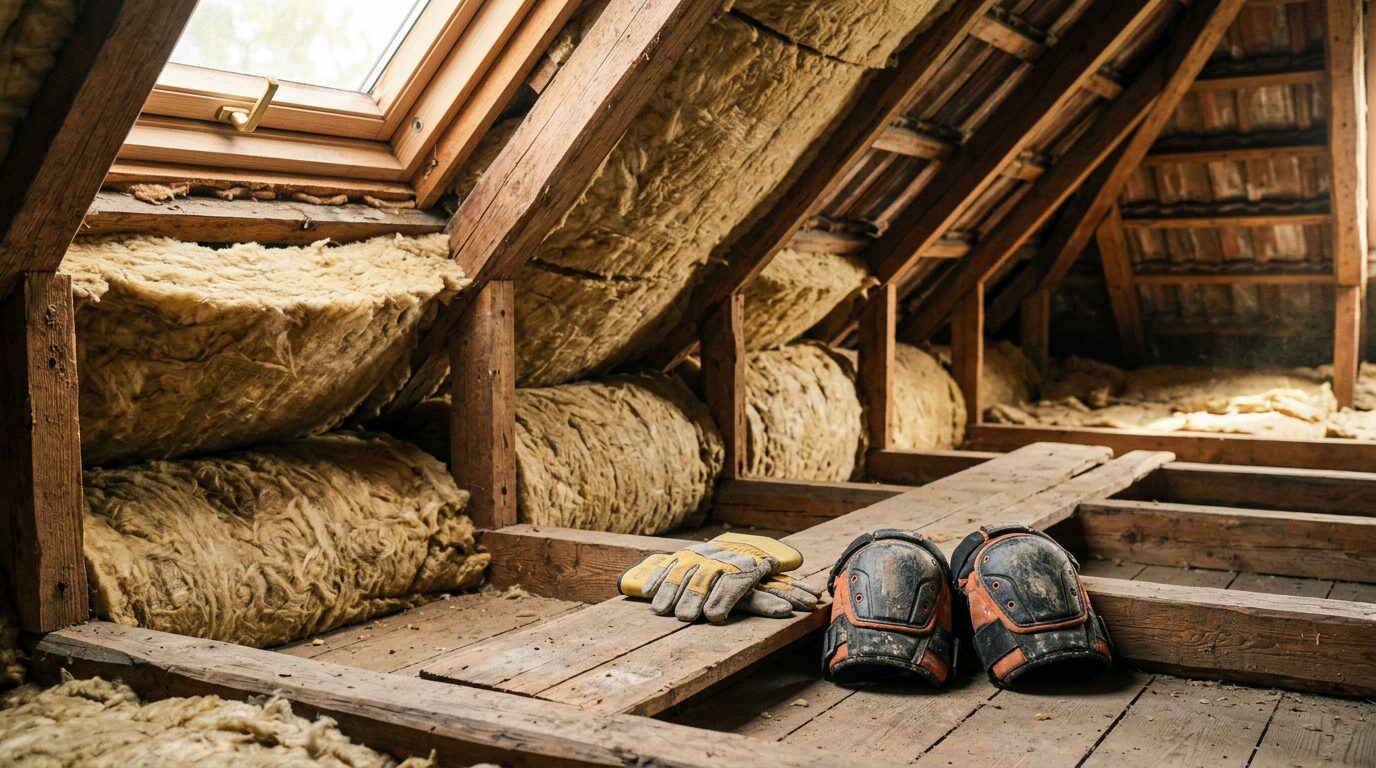
- The loft: warm air rises, and a thinly insulated loft is often the house’s biggest source of heat loss. It is one of the cheapest jobs per m², because insulation is usually just blown in or laid on top of the existing layer.
- The cavity wall: if the house has an uninsulated cavity wall, it can be filled with granulate from the outside in a day. Bolius (the Danish homeowners’ knowledge centre) has calculated an example where the payback time was 2–4 years. Note that cavity walls do not get a grant from Energirenoveringspuljen, but they do qualify for håndværkerfradrag.
- Draught-proofing and controls: sealing strips, thermostatic valves and a correctly set heating curve cost little and can often be done the same weekend.
- Windows: new energy-efficient glazing gives comfort and savings, but it is expensive per m², so the payback time is longer. It makes most sense when the windows need replacing anyway.
- Floor and exterior walls: insulating the ground-floor slab and insulating exterior walls from outside are big projects. They fit in best when the floor or the facade needs renovating anyway.
Your energimærke (energy label) shows the suggested improvements that suit your particular house, with price and saving. If you do not have an energy label, it is a good place to start. It is also a requirement if you want to apply to Energirenoveringspuljen.
Prices and grants per m²
Energistyrelsen (the Danish Energy Agency) uses these estimated market prices (including VAT, labour and materials) to calculate the grant in Energirenoveringspuljen. They are a good benchmark when you get quotes:
| Measure | Market price per m² | Grant per m² |
|---|---|---|
| Insulating the roof and loft (used, unused and flat roof) | DKK 470 | DKK 70 |
| Insulating the ground-floor slab / converting a crawl space to a ground-floor slab | DKK 700 | DKK 105 |
| Exterior insulation of solid and lightweight exterior walls | DKK 1,200 | DKK 180 |
| Replacing facade or roof windows, coupled-frame windows and secondary glazing | DKK 6,800 | DKK 680 |
| Water-based space heating (radiators and underfloor heating) instead of electric heating | DKK 520 | DKK 80 |
So the grant is around 15% of the market price for insulation and 10% for windows. A ventilation system with heat recovery in a detached house has a fixed price of DKK 65,000 and a grant of DKK 10,000. If your total grant is between DKK 5,000 and 10,000, you can also get DKK 750 towards the energy label.
Example: a 100 m² loft
At Energistyrelsen’s market price, insulating a 100 m² loft costs approx. DKK 47,000. The grant from Energirenoveringspuljen is 100 × DKK 70 = DKK 7,000.
If you choose håndværkerfradrag instead, and half the price is labour, two adults in the household can each deduct DKK 9,000. That is worth approx. 2 × DKK 2,340 = approx. DKK 4,700. Here the grant scheme gives the most, but it requires energy label D–G and an approval before the work starts.
Energirenoveringspuljen: how to get a grant
Energirenoveringspuljen is run by Energistyrelsen, and you apply via sparenergi.dk. It opened for applications on 27 January 2026, and the money is allocated on a first come, first served basis. To get a grant you must meet 5 requirements:
- The house is a year-round home, and you own it yourself.
- The house has a valid energy label in category D, E, F or G, based on a building inspection, and no changes may have been made since.
- The project must not have started when you apply. You may only start once you have received approval.
- You must not receive other public support for the same project, e.g. håndværkerfradrag.
- The work is carried out by a company with a valid CVR number (Danish company registration number).
No grants are given for cavity walls, basement exterior walls, basement floors or crawl spaces (unless converted into a ground-floor slab). Processing can take up to 4 months, and the grant is only paid out once you have applied for payment after the work is done.
Håndværkerfradrag for green home improvements
Håndværkerfradrag was reintroduced on 1 January 2025. In 2026, each person over 18 in the household can deduct up to DKK 9,000 for labour on green home improvements (DKK 8,600 in 2025). The deduction is worth approx. 26%. It covers, among other things:
- Insulating the roof and loft, exterior walls including cavity walls, ground-floor slab and crawl space.
- New windows and panes, patio doors, secondary glazing and new exterior doors.
- Heat pumps (installation, servicing and repair), thermostatic valves, radiators, underfloor heating, solar panels and ventilation with heat recovery.
You only get a deduction for the labour, not the materials, so ask the tradesperson to list labour and materials separately on the invoice. You must pay electronically (e.g. bank transfer or MobilePay), not in cash, and report the deduction yourself on skat.dk, where you log in with MitID.
Grant scheme or deduction?
- Choose the grant scheme for bigger projects such as the loft, windows, ground-floor slab or exterior walls, if your house has energy label D–G and you can wait for an approval.
- Choose the deduction for cavity walls, smaller jobs, houses with energy label A–C, or if you do not want to wait.
- You can use the grant scheme for one project and the deduction for another, just not both for the same one.
Insulate first, then choose a heat pump
A better insulated house has lower heat loss. If you insulate first, you can often make do with a smaller heat pump, and it runs more efficiently because the radiators can manage with a lower temperature. If you are thinking about replacing an oil boiler, gas boiler or electric heating, you can also get DKK 27,000 from Varmepumpepuljen, which is open for applications. See our comparison of 11 air-to-water heat pumps, and work out how much you can save (in Danish).
Get a calculation for your house
Would you like a quote for a heat pump that suits your house after insulating? H-Energi ApS provides a free heat loss calculation and a fixed quote. Get 3 quotes at varmepumpe-lufttilvand.dk (our partner, in Danish).
Avoid the typical mistakes
- Damp: insulation needs a tight vapour barrier on the warm side and ventilation on the cold side. Otherwise condensation and mould can develop, especially in the loft.
- Do not start too early: if you start before you have approval from Energirenoveringspuljen, you lose the right to the grant.
- Get several quotes: use Energistyrelsen’s market prices as a benchmark, and ask for a description of thickness, material and vapour barrier.
- Do not forget the energy label: it shows you what pays off in your particular house, and it is needed for a grant.
Frequently asked questions
Does it pay to add insulation?
Yes, especially the loft and cavity walls if they are poorly insulated today. The saving depends on what you heat with and how much insulation is already there. Your energy label gives a concrete estimate for your house.
Can I get a grant for cavity wall insulation?
Not from Energirenoveringspuljen, but you can get håndværkerfradrag for the labour.
Can I get both a grant and håndværkerfradrag?
Not for the same project. You can apply to the grant scheme for, say, the loft and use the deduction for the cavity wall.
What if my house has energy label C or better?
Then you cannot apply to Energirenoveringspuljen, but you can still use håndværkerfradrag.
Can I insulate the loft myself?
Yes, many people insulate an unused loft space themselves. You save the labour cost, but you get neither a grant nor a deduction: the grant scheme requires a company with a CVR number, and håndværkerfradrag only applies to paid labour. Be careful with the vapour barrier and ventilation.
Read also: New windows: price, grants and when it pays off (in Danish) · Energy label: what is it, and when do you need one? · Solar panels 2026: do they pay off? (in Danish)
Sources
- SparEnergi (Energistyrelsen): Energirenoveringspuljen, requirements and what grants are given for (in Danish)
- SparEnergi: Grant rates and market prices (in Danish)
- SparEnergi: Apply for grants (Varmepumpepuljen and Skrotningsordningen, in Danish)
- Skattestyrelsen (the Danish Tax Agency): Håndværkerfradrag
- Bolius: Does adding insulation pay off? (in Danish)
This guide is for general guidance. Check the current conditions on sparenergi.dk and skat.dk before you start a project.
Få et uforpligtende tilbud på varmepumpe
Vores samarbejdspartner H-Energi ApS rådgiver om og installerer varmepumper. Udfyld formularen, så kontakter de dig med et gratis og uforpligtende tilbud.