Boligfritid.dk is a Danish magazine for homeowners. This English version is written for international residents in Denmark. Read the original in Danish.
Updated 23 October 2026. There is a lot you can do yourself at home, but work on electricity, water, drains and gas is regulated by the Danish Authorisation Act (autorisationsloven). If you get something wrong, it can cause fire, electric shock or water damage, and your insurance may refuse to pay out. Here is the list of what you are allowed to do yourself, and when to call an authorised installer.
In short
| Task | Can you do it yourself? |
|---|---|
| Replace a switch in an existing installation | Yes |
| Replace an indoor socket (max. 250 V) | Yes, if the installation is protected by an RCD (HPFI) of 30 mA |
| Fit a new socket or switch where there was none before | No |
| Fit a light in an existing outlet | Yes |
| Replace a socket or light outdoors | No (you may change bulbs) |
| Connect a fridge, washing machine or tumble dryer with a plug | Yes |
| Connect an oven, cooker and cooker hood with a plug, without tools | Yes |
| Replace a tap, mixer tap and shower fittings | Yes, if there is a stopcock in the home |
| Replace a toilet | Yes, if the new one fits and there is a stopcock |
| Replace a radiator | Yes (with district heating there may be local rules) |
| Install water-based underfloor heating | Yes (electric underfloor heating requires an autoriseret elinstallatør, an authorised electrician) |
| Work on a gas installation or gas boiler | No |
| Sewer work | No, it requires an authorised drainage contractor (autoriseret kloakmester) |
Electrics: what you can do yourself
According to Sikkerhedsstyrelsen (the Danish Safety Technology Authority, now part of Erhvervsstyrelsen, the Danish Business Authority), as a private individual you may:
- Replace a switch in an existing installation.
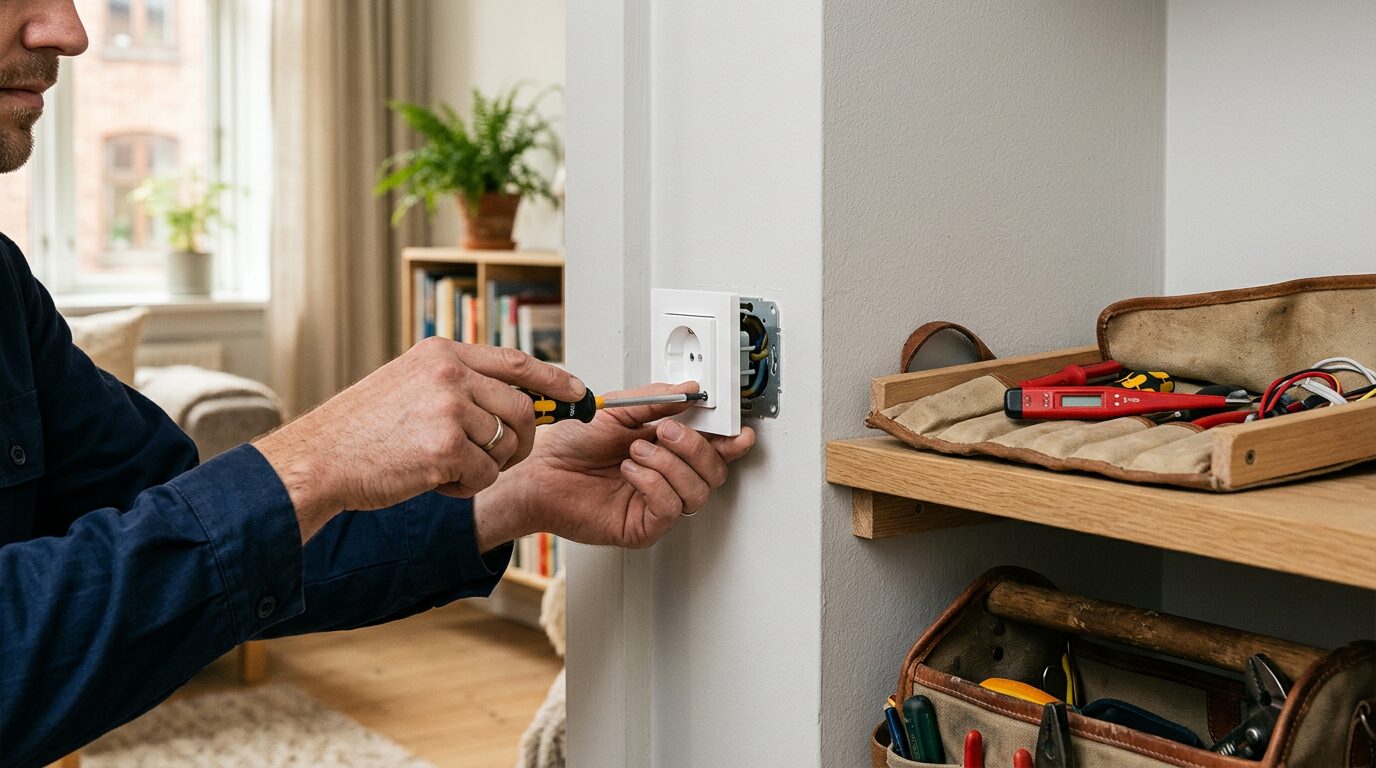
- Replace indoor sockets, with and without earth, for no more than 250 volts in your home, if the installation is protected by a residual current device (RCD/HPFI of 30 mA).
- Fit lights in existing outlets.
- Run cables from sockets or from outlets to lights.
- Connect a fridge, washing machine, tumble dryer and fan with a plug.
- Connect an oven, cooker and cooker hood if they have a plug and it can be done without tools.
- Replace a dishwasher if there is a stopcock and the right plug.
The condition is always that you know how to do it correctly. If the work requires bigger changes, an authorised electrician must do it.
Electrics: what you must not do
- Work on the fixed installations, e.g. new cables in the wall, new circuits or changes to the fuse board.
- Fit a new socket or switch where there has not been one before.
- Outdoor electrics: the rules are stricter here. For example, you may not replace an outdoor socket or light yourself, but you may change bulbs.
- Install electric underfloor heating and permanently connected appliances without a plug.
Before you touch anything electrical
Switch off the power at the fuse board. It is not enough to switch off at the wall switch. Check with a voltage tester that there is no power before you start, and do not switch the power back on until everything is assembled.
Plumbing: what you can do yourself
- Replace a tap or mixer tap.
- Replace shower fittings and mixer taps if there is a stopcock in the home.
- Replace a toilet if the new one is the right size and there is a stopcock.
- Replace a radiator. If you have district heating, ask your supplier whether there are local rules.
- Install water-based underfloor heating.
Plumbing: what you must not do
- Work on gas installations, e.g. repair the gas boiler or remove the gas installation.
- Make new water installations, e.g. run new water pipes, or move drains.
- Sewer work. This requires an authorised drainage contractor.
Why the rules matter
- Safety: faults in electrics can cause shocks and fires. Faults in water and drains can cause major water damage.
- Insurance: if damage is caused by illegally performed work, the insurer can refuse to cover it.
- Selling your home: the electrical installation report (elinstallationsrapport) made when you sell can reveal illegal installations.
If you use an authorised installer, you can check their authorisation in Sikkerhedsstyrelsen’s authorisation register, and the labour cost can in some cases qualify for håndværkerfradrag (tax deduction for home improvement work).
Read more
- Replace a socket and switch yourself: the rules and how to do it (in Danish)
- Replace a tap and toilet yourself: what you need to know (in Danish)
Sources
- Sikkerhedsstyrelsen: Which electrical work can you do without authorisation? (in Danish)
- Sikkerhedsstyrelsen: How to replace a socket (in Danish)
- Sikkerhedsstyrelsen: Which plumbing work can you do without authorisation? (in Danish)
- Sikkerhedsstyrelsen: Outdoor electrics (in Danish)
- Retsinformation: Executive order on simple work that anyone may carry out (in Danish)
This guide is for general guidance only. If in doubt, use an authorised installer.