Boligfritid.dk is a Danish magazine for homeowners. This English version is written for international residents in Denmark. Read the original in Danish.
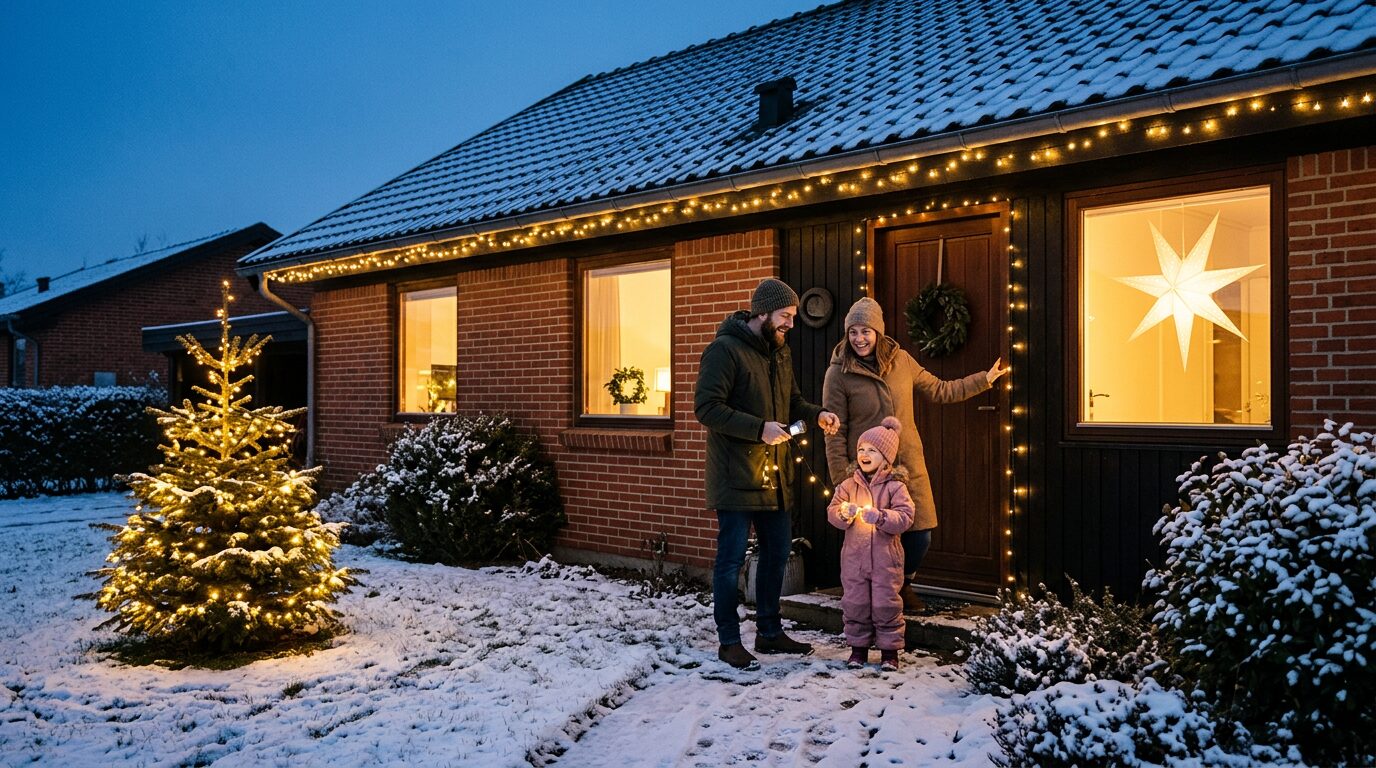
Fairy lights in the hedge, a star in the window and a glowing Christmas tree: Christmas lights are a big part of Danish julehygge (Christmas cosiness). With the right choices, they can be more beautiful, cheaper and safer. Here is a practical guide to Christmas lights outdoors and indoors.
In short
- Choose LED: an LED light string typically uses around 80% less electricity than one with incandescent bulbs, and lasts many times longer.
- Use a timer: lights on from 16:00 to 23:00 instead of around the clock saves about 70% of the electricity, according to Energistyrelsen (the Danish Energy Agency).
- Outdoor light strings must be marked for outdoor use.
- If a light string uses more than 30 W, it is probably not LED.
Warm or cool light? Choose the right mood
The colour of the light matters more for the Christmas mood than most people think. Light colour is measured in kelvin (K). Warm white light of around 2,200–2,700 K resembles candlelight and old incandescent bulbs and gives the classic, cosy Christmas feel. Cool white light above approx. 4,000 K looks bluer and more modern, but can easily feel cold in a Danish winter garden.
- Stick to one light colour per area. Warm and cool white side by side quickly looks messy.
- Layer the light: a light string along the gutter, a couple of lit-up bushes and lights by the front door give depth instead of one big patch of light.
- Less can be more: a few well-placed strings are often more beautiful than lots of flashing ones.
- If you want to know more about how light and colour affect the mood, read our article on colours and mood in the home (in Danish).
Outdoor Christmas lights: what you need to know
- Only light strings marked for outdoor use may be used outside. They have to withstand rain and frost and have better insulation.
- Do not trap the cable in a window or door. Use an outdoor socket, or choose battery-powered or solar light strings.
- Never mix low-voltage strings (12/24 V) with 230 V strings on the same connection, and do not join more strings together than the manufacturer allows.
- Throw out damaged strings as small electrical waste if the insulation on the cable is broken.
- Be careful with cheap light strings from foreign online marketplaces. Check for recalled products on produkter.dk, the website of Sikkerhedsstyrelsen (the Danish Safety Technology Authority).
How much electricity do Christmas lights cost?
The calculation is simple: watts ÷ 1,000 × number of hours × the electricity price. Below, we have calculated the cost of one light string for 40 days, from the start of December until after Epiphany (helligtrekonger), at an electricity price of DKK 1.80 per kWh including duties and VAT. Use your own electricity price if you know it; you can see the current price on our page about today’s electricity price (in Danish).
| Light string | On around the clock | On 16:00–23:00 |
|---|---|---|
| Old light string with incandescent bulbs (80 W) | approx. DKK 138 | approx. DKK 40 |
| Light string with halogen/small incandescent bulbs (35 W) | approx. DKK 60 | approx. DKK 18 |
| LED light string (5 W) | approx. DKK 9 | approx. DKK 3 |
So one LED string costs only a few kroner for the whole of Christmas. If you have lots of old strings with incandescent bulbs and leave them on day and night, it can add up to several hundred kroner. If you are unsure what your own strings use, look at the label or borrow an energy meter. We have also written about how to avoid being ruined by your Christmas lights (in Danish).
Indoors: the Christmas tree, windows and living room
The Christmas tree
- Choose an LED light string with warm white light, and check the packaging to see what height of tree it suits.
- Wind the lights from the bottom up, and let the string follow the branches inwards towards the trunk, so the light seems to come from inside the tree.
- Switch off the tree lights when you go to bed or leave the house.
Windows and living room
- A Christmas star or light decoration in the window shines both inwards and outwards, and LED versions do not get hot.
- Consider battery-powered light strings with a timer in decorations, so you do not have to run cables.
- In children’s rooms, light strings should hang out of children’s reach. Low-voltage strings are a good choice.
Real candles belong to Christmas, but they also cause more fires in December. Read our guide to a fire-safe Christmas before you light the Advent wreath.
Frequently asked questions
How many hours should Christmas lights be on?
A good starting point is from dusk until bedtime, for example 16:00–23:00. With a timer you do not have to remember, and you save about 70% of the electricity compared with leaving them on around the clock.
Can I use indoor light strings outside?
No. Indoor light strings are not built for rain and frost and can cause short circuits and a fire risk. Only use light strings that are marked for outdoor use.
How do I know if my light string is LED?
Look for the wattage on the label. An LED light string typically uses only a few watts, whereas a string above approx. 30 W probably has incandescent bulbs.
Sources
- Tænk (Forbrugerrådet Tænk, the Danish Consumer Council): Get on top of electricity use and safety when you switch on light strings (in Danish) (Energistyrelsen’s figures for hours and LED).
- Bolius: How much electricity do outdoor Christmas lights cost? (in Danish)
- Boligsiden: More Christmas cosiness, less electricity use (in Danish) (SparEnergi: LED uses approx. 80% less electricity).
Få nyhederne i din indbakke
Nyheder, guides og gode råd til dig, der ejer din bolig. Du vælger selv, hvor ofte du vil have dem.


